




Princess cut engagement rings,made in Australia.
The princess cut is what most people mean when they say "a square diamond." Sharp corners, brilliant faceting, and more sparkle per carat than any square shape ever cut. It's the second most popular diamond shape for engagement rings in Australia after the round brilliant, and for a specific reason. The princess cut lets you buy a bigger, brighter diamond for the same budget as a round of the same weight, because the cutter loses less material from the original rough. That maths has never changed.
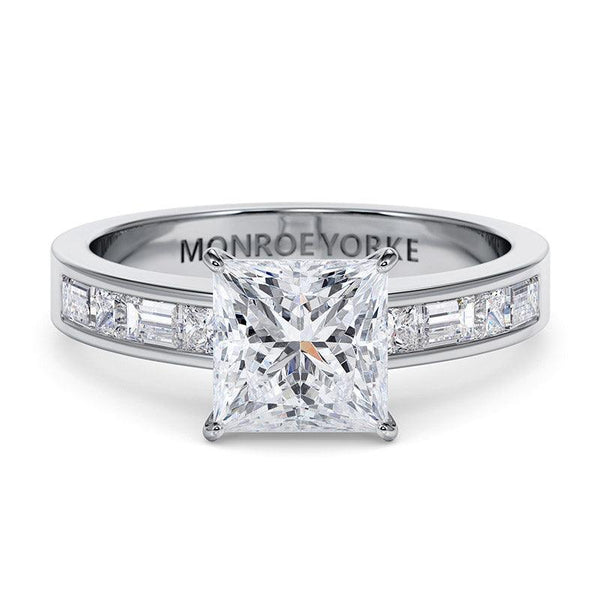
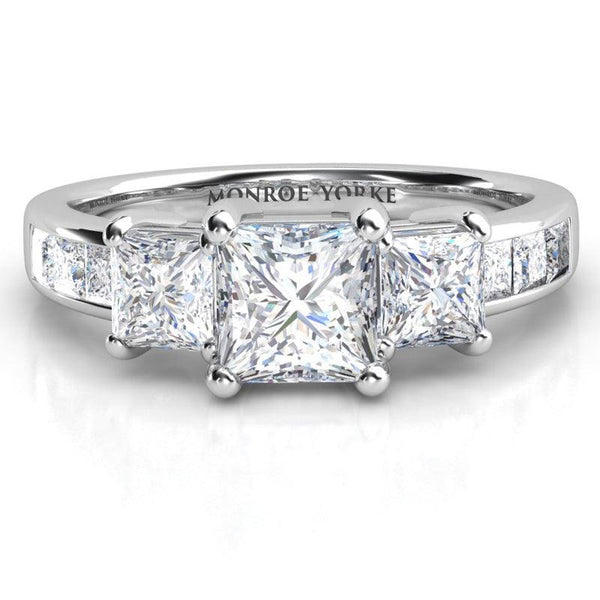
Made in Australia, set to protect the corners.
Every princess cut engagement ring in this collection is set in eighteen-carat gold or 950 platinum and hand-finished in our Sydney workshop. Every centre diamond is either a GIA-certified natural or an IGI-certified lab-grown, sourced and graded by our founder Sean Amara, a gemmologist trained at the Gemological Institute of America and HRD Antwerp. Every corner is protected by a V-prong or chevron-prong setting, because a princess cut's sharp corners are the most chip-vulnerable point on any diamond shape, and prong choice is the difference between a ring that lasts a lifetime and one that needs repair in five years.
The princess cut suits couples who want a modern, geometric, unmistakably contemporary silhouette. It suits diamond buyers who want maximum face-up size for their budget. It doesn't suit everyone equally. The sharp geometry can read cold against warm metal without a considered setting choice, and colour tint shows through more visibly than in a round. What follows is our master jeweller's field guide to choosing the right princess cut engagement ring, and to sidestepping the mistakes most first-time buyers only learn about after the ring is on the hand.
Design your perfect ring.
Collaborate with our master jeweller to create a bespoke princess cut engagement ring, made only for the person you are proposing to. Free consultation, no obligation. Six to eight weeks in our Australian workshop.
Steve GilbeySean was great to deal with, professional, knowledgeable and followed through with exactly what he promised. The quality of the ring is excellent and my fiancé and I are thrilled. I would highly recommend Monroe Yorke!
Every ring, hand-finished by our master jeweller.
Ten stages over four to eight weeks. Design, 3D model, cast, source stones, clean, polish, set, eight hours of final finish, quality check, rectify. No shortcuts.
Cut for perfect light return.
A well-cut diamond throws light back at you across a room. A poorly cut one absorbs it and sits quiet on the finger. That difference is the single biggest thing you'll notice, and it's what we grade every stone against before it goes into a ring.
Cut.Excellent (natural) or Ideal (lab), no exceptions. This is what makes a diamond return light rather than absorb it.
Symmetry and polish.Both graded Excellent. It's why hearts and arrows show up cleanly under a scope.
Fluorescence.None or faint, never medium or strong. Keeps the diamond bright in every light.
Colour.D–G for naturals, D–E for labs. Cool white in yellow gold and platinum, without paying for a D flawless.
The princess cut ring, in depth.
A gemmologist's field guide. Eleven sections. Fifteen minutes to read. Written by Sean Amara, founder, trained at GIA and HRD Antwerp.
01Why the princess cut matters
The princess cut is the second-most-popular diamond shape for engagement rings in Australia. Round brilliant is No. 1 (and will be for another decade). Everything else, oval, cushion, emerald, pear, sits below princess. So princess is the biggest of the "non-round" category. If you want a diamond that is unmistakably modern, unmistakably geometric, and unmistakably not what your mother wore, this is the shape.
Two other reasons couples choose it. First, price per face-up size. The princess cut yields more usable diamond from a raw octahedral rough than a round brilliant, typically 60 to 70% yield versus 40% for a round. That means a 1-carat princess costs roughly 20 to 30% less than a 1-carat round of equivalent quality, and reads larger on the finger. Second, sparkle style. A princess cut throws big, sharp flashes rather than the fine white fire of a round. Some people love that. Some don't.
02How the princess cut was actually invented
The princess cut has a tangled origin story that most jewellers get wrong. The truth is it evolved in two stages, forty years apart.
Basil Watermeyer, a South African cutter, developed the Barion cut in 1961, a square modified brilliant with a crushed-ice appearance. This is the diamond most people mean when they say "the princess cut was invented in 1961."
The modern princess cut, the square shape sold today with 57 or 76 facets and the distinctive chevron pattern beneath, was developed by Israeli cutters Betzalel Ambar, Israel Itzkowitz and Ygal Perlman around 1980. It was originally called the "Quadrillion cut" and was patented in 1981. The name "princess cut" came into general use in the 1990s and stuck.
Both cuts share the same design goal, maximum brilliance in a square shape, but the modern princess is the one you buy today. If a jeweller tells you the princess cut is a "1961 invention" they are technically talking about the Barion. It doesn't affect what you're buying. It does tell you how carefully the person selling you the ring knows their history.
03Facets, sparkle, and the chevron pattern
A princess cut has either 57 or 76 facets depending on how the pavilion is chevron-cut. That's the biggest technical variable most buyers don't know about.
Look at a princess cut diamond from the side, through the pavilion (the pointed underside). You'll see chevron shapes running from the corners toward the culet. Cutters choose 2, 3, or 4 chevrons per side.
Two chevrons produce larger, contrasting flashes. Fewer facets, bigger sparkles, more "hall of mirrors" look.
Three chevrons are the middle ground, the most common cut.
Four chevrons produce many tiny facets. The sparkle reads more like a "crushed ice" scintillation. Some buyers prefer this. Some find it busy.
Ask your jeweller how many chevrons the diamond has before you buy. Ask to see a two-chevron and a four-chevron side by side. The difference is dramatic and it's a matter of personal taste, not quality. We have both patterns available in our Sydney workshop for viewing.
04Length-to-width ratio: square or slightly rectangular
A princess cut can be perfectly square or slightly rectangular. The length-to-width ratio (L/W) tells you which.
1.00 to 1.05 is a true square. This is what most people picture when they hear "princess cut."
1.05 to 1.10 is subtly rectangular, you may not notice from directly above but will from an angle. Some people prefer this for the elongating effect on the finger.
Above 1.10 starts to look distinctly rectangular. Verges on "radiant cut" territory.
Ask for the L/W ratio on the diamond certificate before you buy. GIA and IGI both report it. If you specifically want a true square, look for 1.00 to 1.03. If you want a subtle finger-lengthening effect, look for 1.05 to 1.10. Anything above should be considered a rectangular princess.
05Depth, table, and cut quality signals
Cut quality matters more in a princess than in almost any other shape, because a poorly cut princess looks dull instead of sparkling. What to look for on the certificate:
Depth: 62 to 74% is the acceptable range. Below 62% and the diamond looks dull; above 74% and light leaks out the bottom. Ideal is 65 to 72%.
Table: 65 to 75% is the acceptable range. This is the flat top facet as a percentage of the overall width. Below 65% the crown angles are too shallow; above 75% and the crown is flat, killing sparkle.
Symmetry and polish: both must be graded Excellent for a princess cut. Very Good is a compromise. Anything lower and you'll see it under a loupe.
Cut grade: GIA does not issue an official "cut grade" for princess cuts (only for rounds). IGI does. Look for "Very Good" or better on an IGI princess cut certificate. On a GIA-graded princess, ask your jeweller to walk you through the depth, table, and symmetry numbers instead, those tell the same story.
Every princess cut we set is inspected against these numbers before it goes into a ring. Our founder personally reviews every centre stone.
06Corner protection: V-prong or chevron prong
This is the most important paragraph on this page.
The princess cut has four sharp 90-degree corners. Each corner is the weakest point on the diamond, the place most vulnerable to chipping if the ring catches on fabric, a bench, a car door.
A well-set princess cut solves this in two ways. First, the metal setting covers each corner with a V-shaped prong (also called a chevron prong) that wraps around the corner rather than sitting flat against it. Second, the diamond is set deep enough into the metal that the corner is recessed and protected.
If you see a princess cut set with a standard round prong sitting at the corner, walk away. That's the setting most likely to result in a chipped diamond within five years. Every princess cut ring we make uses V-prong or chevron-prong corner protection as standard. It's not optional.
If you already own a princess cut ring and aren't sure if the corners are properly protected, bring it to any of our four showrooms and we'll assess it for free.
07Colour and clarity: what to look for in a princess
The princess cut holds colour more visibly than a round brilliant. That means the same diamond colour grade looks warmer in a princess than in a round.
Colour recommendations. In white metal (white gold, platinum), choose F to H for a colourless appearance. Below H and the warm tint will be visible. In yellow gold, you can drop to H to J because the metal absorbs some of the warmth (see our yellow gold guide for the science).
Clarity recommendations. The chevron facet pattern beneath a princess cut hides small inclusions well in the centre of the diamond. But inclusions near the corners are exposed by the V-prong setting and are more visible. Aim for SI1 or better on the certificate, and ask your jeweller to specifically check corner-area inclusions before you commit. VS2 or better is the safe choice if budget allows.
This is a matter of matching the diamond to the setting. We check every stone against its intended setting before we cut, set, or ship.
08Princess vs round, cushion, asscher, radiant
Buyers considering a princess cut usually cross-shop against three or four other shapes. Here's the honest comparison.
Princess vs round brilliant. Round has more overall sparkle and hides colour better. Princess is 20 to 30% cheaper per face-up size, reads more modern, and is dramatically different. If you want maximum sparkle, choose round. If you want modern geometry, choose princess.
Princess vs cushion. Cushion has softer, rounded corners and an older, more romantic feel. Princess is sharper, more contemporary, and has more distinct facet flashes. Cushion hides inclusions and colour better; princess shows more of both. Cushion for vintage, princess for modern.
Princess vs asscher. Both are square, but asscher is a step cut (concentric flat facets like emerald cut) rather than a brilliant cut. Asscher has hall-of-mirrors flashes rather than sparkle. Asscher demands VVS clarity or better because inclusions are extremely visible. Princess is more forgiving on clarity. Different aesthetics entirely.
Princess vs radiant. Radiant is a rectangular brilliant cut with cropped (chevron-like) corners. Radiant sparkles more than princess because the cropped corners are cut, not sharp. Radiant is safer to wear (no chip risk). But princess reads cleaner, more geometric, more architectural. Radiant for the safety-conscious active wearer; princess for the design purist.
09Setting styles that suit a princess cut
Solitaire with a V-prong setting is the truest princess cut expression. Modern, uncluttered, corner-protected. If you're not sure, this is the safe choice.
Halo and hidden halo. A halo of small round diamonds around the princess softens the sharp corners visually while adding sparkle. This is our most popular custom request for princess cuts and it flatters almost every hand.
Three stone (trilogy). Princess centre with two round or princess side stones. Reads distinctly modern. The three-stone princess is having a moment right now.
Bezel and half-bezel. The metal fully surrounds the princess corners, giving maximum protection and a distinctly architectural look. Best choice for anyone with an active lifestyle.
Channel-set band with princess centre. A trend from the 2000s that's coming back. Sharp princess flanked by channel-set smaller princesses in the band.
10Metal pairings: should you set a princess in yellow gold?
The sharp geometry of a princess cut can read cold in cool metals (white gold, platinum) and slightly discordant in warm metals (yellow gold, rose gold) unless the setting is chosen carefully.
White gold and platinum are the safe defaults. Sharp geometry meets cool metal. Classical, uncomplicated.
Yellow gold works but requires thought. The warm metal against sharp square corners can feel unbalanced without softening. Two solutions: a halo around the princess (softens visually), or a bezel setting (integrates the corner into the band). Full-yellow-gold princess solitaires with V-prongs look distinctly retro, which some people love and some don't. Try it in person before deciding.
Rose gold works particularly well with princess in three-stone or halo designs. The pink tone softens the sharpness in a way pure yellow doesn't.
Two-tone, yellow gold band with white gold or platinum V-prongs holding the princess, is one of our most-requested custom builds. Best of both worlds.
11Wedding band pairings for princess cut
A princess engagement ring pairs beautifully with several wedding band styles:
Plain solid band in matching metal, the classic minimalist pairing. Lets the princess stone speak.
Tapered channel-set band, small round diamonds tapered toward the engagement ring. Sits flush and elevates the whole set.
Contour band designed to hug the princess setting, sits perfectly flush with no gap. Requires custom or matched design.
Baguette-set eternity band, small rectangular baguette diamonds echo the geometric feel of the princess. Distinctly Art Deco.
Diamond half-eternity in channel setting, smaller princess or round diamonds in a channel, sits comfortably beside the engagement ring.
We custom-design wedding bands to match every engagement ring we make. Bring your finished engagement ring to any of our four showrooms and our master jeweller will design a matching band to sit flush against it.
Your questions, answered.
Sixteen of the questions we hear most often across the showrooms.
What is a princess cut engagement ring?
A princess cut engagement ring is a square (or slightly rectangular) diamond with sharp 90-degree corners and a brilliant cut pattern of 57 or 76 facets. It's the second most popular diamond shape for engagement rings in Australia after the round brilliant.
How many facets does a princess cut have?
Either 57 or 76 facets, depending on whether the pavilion (the pointed underside) is cut with 2, 3, or 4 chevron patterns. More chevrons produce more, smaller facets and a "crushed ice" sparkle. Fewer chevrons produce larger, more contrasting flashes. It's a matter of taste, not quality, ask to see both patterns side by side before choosing.
When was the princess cut invented?
Two stages, forty years apart. Basil Watermeyer developed the Barion cut (a square modified brilliant with crushed-ice sparkle) in 1961. The modern princess cut sold today was developed by Israeli cutters Betzalel Ambar, Israel Itzkowitz and Ygal Perlman around 1980, originally under the name "Quadrillion cut." The name "princess cut" came into general use in the 1990s.
What length-to-width ratio should I choose for a princess cut?
For a true square, choose 1.00 to 1.05. For a subtly rectangular princess that elongates the finger, choose 1.05 to 1.10. Above 1.10 starts to look distinctly rectangular. GIA and IGI both report L/W ratio on the certificate.
What are the ideal depth and table percentages for a princess cut?
Depth 65 to 72% is ideal (62 to 74% acceptable). Table 65 to 75% is the acceptable range. Both symmetry and polish should be graded Excellent. GIA does not issue an official cut grade for princess cuts; IGI does, look for Very Good or better.
Do princess cut diamonds chip easily? How is it prevented?
The four sharp corners of a princess cut are the most vulnerable point on any diamond shape. Chipping is prevented by two things: a V-shaped prong (also called chevron prong) that wraps around each corner, and setting the diamond deep enough that the corners are recessed. Every princess cut ring we make uses V-prong corner protection as standard. If you see a princess cut set with round prongs at the corners, don't buy it.
What colour grade should I choose for a princess cut?
In white metal (white gold, platinum) choose F to H for a colourless appearance. In yellow gold you can drop to H to J because the warm metal absorbs some of the tint. Princess cuts show colour more than rounds, so a J colour in a round will look warmer in a princess of the same grade.
What clarity grade should I choose for a princess cut?
Aim for SI1 or better on the certificate, and specifically ask your jeweller to check for inclusions near the corners. Corner-area inclusions are more visible under the V-prong setting than centre inclusions, which the chevron faceting hides well. VS2 or better is the safe choice if budget allows.
Princess cut vs round brilliant: which is better?
Round brilliant has more overall sparkle and hides colour and clarity issues better. Princess is 20 to 30% less expensive per face-up size, reads more modern, and has a distinctly geometric silhouette. If you want maximum sparkle, choose round. If you want modern geometry and better value per size, choose princess.
Princess cut vs cushion: what's the difference?
Princess has sharp 90-degree corners; cushion has rounded, pillow-like corners. Princess sparkles with distinct facet flashes; cushion has a softer, older, more romantic sparkle. Cushion hides inclusions and colour better. Choose cushion for vintage character, princess for modern geometry.
Princess cut vs asscher: what's the difference?
Both are square, but asscher is a step cut (concentric flat facets like emerald cut) rather than a brilliant cut. Asscher gives "hall of mirrors" flashes instead of sparkle. Asscher demands VVS clarity or better because inclusions are extremely visible in a step cut. Princess is more forgiving on clarity and gives brilliant-cut sparkle.
Which wedding band suits a princess cut engagement ring?
Several styles work. A plain solid band is the classic minimalist pairing. A tapered channel-set band adds subtle sparkle. A contour band custom-designed to hug the setting sits perfectly flush. A baguette-set eternity band echoes the geometric feel. We custom-design wedding bands to match every engagement ring we make.
Does yellow gold work with a princess cut?
Yes, with thought. Sharp geometry against warm metal can feel unbalanced without a softening element. Two solutions: a halo around the princess (softens visually), or a bezel setting (integrates the corner into the band). Two-tone (yellow gold band with white gold or platinum V-prongs) is a popular custom request. Full-yellow-gold princess solitaire is a distinctly retro look, try it in person before deciding.
Are lab-grown princess cuts cheaper than natural princess cuts?
Yes, typically 40 to 50% less at the same size and quality. Lab-grown diamonds are chemically, optically and physically identical to natural diamonds. Every design in this collection can be made with either a GIA-certified natural or an IGI-certified lab-grown princess cut. We don't push one over the other, we help you decide based on what you want.
How do I care for a princess cut engagement ring?
Two things matter more than for other shapes. First, check the corner prongs every 6 months for wear, the corners are where the metal takes the most stress. Second, avoid activities where the ring can catch on fabric, gym equipment, or hard surfaces (the corners chip). Everything else is standard: warm water with a drop of dish soap for home cleaning, professional polish every 12 to 18 months at one of our showrooms, all covered under our lifetime warranty.
Can I see princess cut engagement rings in person at your Sydney, Melbourne, Brisbane or Perth showroom?
Yes. We recommend it. Princess cuts look different in person than through a screen, the sharp corners catch the light in ways photos can't reproduce. Book a private appointment at any of our four showrooms. Bring the recipient if you can, or a photo and their ring size. Allow forty-five minutes.
See princess cut in person.
A princess cut looks different in person than it does through a screen. The sharp corners catch the light in a way photos can't reproduce. Private appointments across our four Australian showrooms. No walk-in pressure.
Every centre stone, certified.
Every engagement ring centre diamond that leaves our Australian workshop carries an independent certificate. Pavé and melee accent stones are hand-selected to match, but are not individually certified.


