


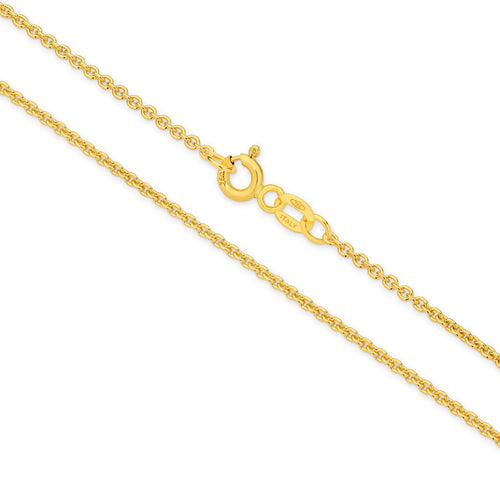


Yellow gold,made in Australia.
Every ring in this collection is 18ct yellow gold, hand-finished by our master jeweller in our Australian workshop. Every centre diamond independently graded by GIA (natural) or IGI (lab-grown). Every stone hand-selected by our founder, a gemmologist trained at GIA and HRD Antwerp.


Design your perfect ring.
Collaborate with our master jeweller to create a bespoke yellow gold engagement ring, made only for the person you are proposing to. Free consultation, no obligation. Six to eight weeks.
Amy & Jack · Perth · 2026We flew from Perth to see the ring in person and left knowing we'd got something no one else would have. Sean answered every question I didn't know I had.
Every ring, hand-finished by our master jeweller.
Ten stages over four to eight weeks. Design, 3D model, cast, source stones, clean, polish, set, eight hours of final finish, quality check, rectify. No shortcuts.
Cut for perfect light return.
A well-cut diamond throws light back at you across a room. A poorly cut one absorbs it and sits quiet on the finger. That difference is the single biggest thing you'll notice, and it's what we grade every stone against before it goes into a ring.
Cut.Excellent (natural) or Ideal (lab), no exceptions. This is what makes a diamond return light rather than absorb it.
Symmetry and polish.Both graded Excellent. It's why hearts and arrows show up cleanly under a scope.
Fluorescence.None or faint, never medium or strong. Keeps the diamond bright in every light.
Colour.D–G for naturals, D–E for labs. Cool white in yellow gold and platinum, without paying for a D flawless.
The yellow gold ring, in depth.
A gemmologist's field guide. Eleven sections. Fifteen minutes to read. Written by Sean Amara, founder, trained at GIA and HRD Antwerp.
01Why yellow gold matters again
For most of the twentieth century, yellow gold was the default engagement ring metal in Australia. From the 1990s onwards, platinum and white gold took over. Fashion swings. Yellow gold has been climbing steadily since around 2022 and is now the fastest-growing metal preference across our four showrooms.
02What 18ct means and the 750 hallmark
Every yellow gold ring we make is 18ct: 75% pure gold plus 25% alloy. Look inside the band. 750 is stamped there. That's the international hallmark for 18ct. 14ct = 585. 9ct = 375. Nine-carat fades and thins over decades. We don't make 9ct or 14ct engagement rings.
03How yellow gold changes how a diamond looks
A diamond in the G–J colour range has a slight warm tint. In yellow gold, the metal absorbs some of that warmth and the diamond appears whiter than it would in a cold white metal.
Practical implication. If you want maximum face-up size for budget, yellow gold lets you drop two colour grades without visible compromise. Typically 15–25% saving on the stone.
04Choosing a diamond shape for yellow gold
Every shape works. Some sing. Round brilliant is timeless. Oval and elongated cushion trend fastest. Emerald and Asscher take on Art Deco character. Marquise and pear suit yellow gold better than white gold. Princess works but a bezel solves the sharp geometry.
05Coloured gemstones and yellow gold
Yellow gold is the strongest metal for coloured stones. Yellow sapphire, champagne diamond, emerald (Cartier, Bulgari), ruby, pink sapphire, morganite: all sing. Less confident with tanzanite and aquamarine.
06Setting styles that suit yellow gold
Solitaire is the truest yellow gold expression. Halo and hidden halo add sparkle without a second metal. Trilogy feels warm and personal. Bezel and half-bezel are the modern architectural choice.
07Yellow gold and skin tone in Australian light
Yellow gold suits warm and olive skin best. Under Australian sunlight it reads even warmer than in European light, a particularly good match for Australian summer skin.
Cool undertones can still work in a two-tone design. See the ring under three lights (showroom, natural daylight, warm indoor evening) before deciding.
08Yellow gold or rose gold, how to choose
Three things decide it. Skin tone (yellow suits warm/olive; rose suits almost all). Personality (yellow reads classic; rose reads romantic and distinctive). Longevity (yellow is stable for life; rose deepens slightly as copper oxidises).
09Family gold, recycled gold, heirloom rings
Bring family gold to any of our showrooms. Our master jeweller assesses gold content, tests purity, confirms workability. In most cases we can melt it down and add it to our 18ct alloy. Centre diamond is new and independently certified. Metal carries the family story. Or 100% recycled 18ct on request. Both add about 2 weeks.
10What you should expect to pay in Australia
Natural GIA-certified diamond. 0.75ct H-VS2 solitaire, AUD $4,500 to $6,500. 1ct H-VS2 solitaire, AUD $6,500 to $9,500. 1.5ct oval or cushion halo, AUD $12,000 to $18,000. 2ct emerald cut solitaire, AUD $18,000 to $28,000.
Lab-grown IGI-certified (30 to 50% less). 1ct F-VS1 solitaire, AUD $3,500 to $4,500. 2ct F-VS1 oval halo, AUD $6,500 to $9,500. 3ct emerald cut solitaire, AUD $10,500 to $14,500.
Custom design adds 10 to 25%. Family gold or recycled gold doesn't add cost.
11Care and longevity, by lifestyle
Unlike white gold, yellow gold needs no rhodium plating. Desk-based lifestyle: polish every 18 months. Active lifestyle (fitness, cooking): every 12 months. Beach and outdoor: every 9 to 12 months. Never swim in it. All maintenance is included in our lifetime warranty.
Your questions, answered.
Sixteen of the questions we hear most often across the showrooms.
Why only 18ct? Not 14ct or 9ct?
18ct is 75% pure gold, the warm buttery colour yellow gold is known for, plus durability to hold a diamond securely for decades. 14ct is 58% (paler). 9ct is 37% (fades). For a ring worn every day for life, 18ct is right.
What does the 750 hallmark mean?
750 is the international marker for 18ct gold: 750 parts per thousand pure. 585 = 14ct. 375 = 9ct. Every yellow gold ring we make carries 750 inside the band.
Do white diamonds look good in yellow gold?
Yes, often better than in white gold. Yellow gold absorbs the slight warmth in a G–J diamond, so the stone appears whiter than in a cold metal.
Is yellow gold in fashion right now?
Yellow gold has been climbing since around 2022 and is the fastest-growing metal across our four showrooms.
What skin tone does yellow gold suit?
Warm and olive tones best. Under Australian sunlight it reads warmer than in European light. Cool undertones can still work in a two-tone design.
Will yellow gold change colour or tarnish?
No. 18ct doesn't tarnish and doesn't change colour. In forty years it'll be the same tone as day one. No rhodium re-plating needed.
How durable is 18ct for everyday wear?
Durable enough for daily wear if made well. Fine surface scratches develop as patina. A polish every 12 to 18 months keeps it looking newly-made.
Yellow gold band with white gold or platinum head?
Yes. One of our most popular custom requests. Yellow band for warmth, white or platinum head for whiter diamond appearance and rigid strength at the setting.
How does yellow gold compare on price?
18ct yellow, white, and rose gold price identically (all 75% pure gold, alloy differs). Platinum is more expensive per gram. Yellow vs platinum in the same design saves $400 to $1,500 AUD.
Are these rings available with lab-grown diamonds?
Yes. Every design can be made with either a natural GIA-certified diamond or a lab-grown IGI-certified diamond. Lab-grown is chemically identical and typically 30 to 50% less.
Can I use family gold?
Yes. Bring it to any showroom. Our master jeweller assesses whether it can be melted into our 18ct alloy. In most cases yes. Adds about 2 weeks.
Do yellow gold rings hold their value?
Yes, yellow gold holds intrinsic material value well. Gold rises with inflation. 18ct retains its purity for as long as the piece exists. The diamond holds value independently.
Can I customise these designs?
Yes. Change the carat, centre stone shape, setting height, band width, diamond quality, or metal alloy. Custom changes add 2 to 4 weeks.
How long does the ring take to make?
Ring from this collection in your size with your chosen diamond: 4 to 6 weeks. Custom designs: 6 to 8 weeks. Family or recycled gold adds 2 weeks.
Can I see the ring in person?
Yes, always. Book a private appointment at any of our four showrooms. Allow forty-five minutes. No walk-in pressure.
What if it doesn't fit or they don't love it?
Free re-sizing for life on any ring bought from us. 14-day change of mind on stock pieces (not custom).
See yellow gold in person.
Yellow gold looks different in person. The tone under natural light, the way it catches diamond warmth, the weight in the hand. Private appointments across our four Australian showrooms. No walk-in pressure.
Every centre stone, certified.
Every engagement ring centre diamond that leaves our Australian workshop carries an independent certificate. Pavé and melee accent stones are hand-selected to match, but are not individually certified.


