




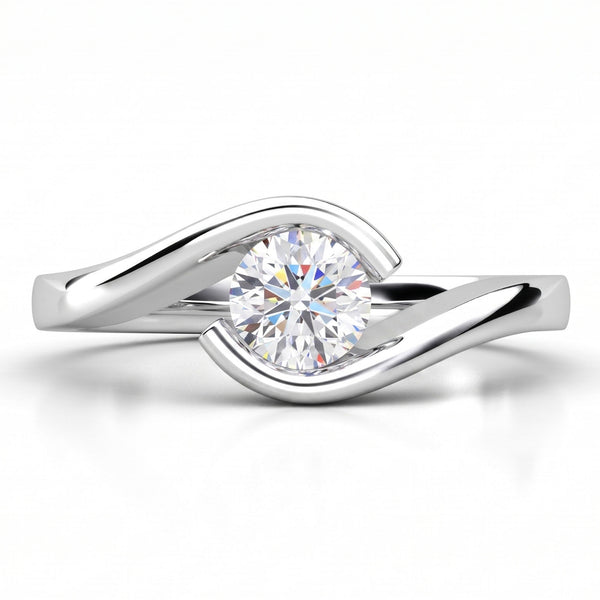
Solitaire engagement rings,made in Australia.
Solitaire engagement rings, hand-finished in our Australian workshop. One centre diamond, no accents, all the light. GIA-certified natural or IGI-certified lab-grown, from 0.30 to 3.00 carats. Choose 4-claw for maximum diamond visibility or 6-claw for security and the classic Tiffany silhouette.


Design your perfect solitaire.
Collaborate with our master jeweller to create a bespoke solitaire, made only for the person you are proposing to. Free consultation, no obligation. Four to six weeks in our Sydney workshop.
Amy & Jack · Perth · 2026We flew from Perth to see the ring in person and left knowing we'd got something no one else would have. Sean answered every question I didn't know I had.
Every ring, hand-finished by our master jeweller.
Ten stages over four to eight weeks. Design, 3D model, cast, source stones, clean, polish, set, eight hours of final finish, quality check, rectify. No shortcuts.
Cut for perfect light return.
A well-cut diamond throws light back at you across a room. A poorly cut one absorbs it and sits quiet on the finger. That difference is the single biggest thing you'll notice, and it's what we grade every stone against before it goes into a ring.
Cut.Excellent (natural) or Ideal (lab), no exceptions. This is what makes a diamond return light rather than absorb it.
Symmetry and polish.Both graded Excellent. It's why hearts and arrows show up cleanly under a scope.
Fluorescence.None or faint, never medium or strong. Keeps the diamond bright in every light.
Colour.D–G for naturals, D–E for labs. Cool white in yellow gold and platinum, without paying for a D flawless.
The solitaire ring, in depth.
A gemmologist's field guide. Eleven sections. Fifteen minutes to read. Written by Sean Amara, founder, trained at GIA and HRD Antwerp.
01Why the solitaire still wins
Every year since the mid-1880s, the single-stone solitaire has been the most popular engagement ring design in the world. It has outlasted the three-stone, the pavé, the halo, the hidden halo, the toi et moi, and every other setting fashion that has come and gone. Every one of those styles has had its moment. The solitaire has had 140 years.
The reason is simple. A solitaire is a proposal reduced to its essential geometry: one person, one diamond, one commitment. Nothing distracts from the stone. Nothing distracts from the meaning. In a category where design trends turn over every decade, that clarity keeps working.
If you're drawn to a solitaire, you're not choosing minimalism because it's fashionable. You're choosing the one setting that has never gone out of style. Three of the top five best-selling engagement rings at our four showrooms every year are solitaires, and that hasn't changed since we opened in 2006.
02The Tiffany 1886 story, where the modern solitaire came from
The modern engagement ring solitaire has a specific inventor and a specific date. Charles Lewis Tiffany introduced the Tiffany Setting in 1886, and it changed engagement ring design permanently.
Before 1886, diamond engagement rings sat in bezel or flush settings. The stones were held tight against the band, and the metal that surrounded them absorbed light before it could enter the diamond. Rings were beautiful but visually flat.
Tiffany's innovation was to lift the diamond above the band on six thin platinum claws. Suddenly, light could enter the stone from every angle, refract through the pavilion, and return to the eye. The diamond didn't just sit on the ring, it floated. Sparkle went up by an order of magnitude.
Every solitaire made anywhere in the world since 1886 traces its DNA back to the Tiffany Setting. The six-prong classic solitaire we make today at our Sydney workshop is a direct descendant of that 1886 invention. The four-prong variant came later as a Deco-era simplification. Both are Tiffany's legacy.
03Prong count, 4 vs 6 vs 8, the buyer's question nobody answers
The single most-asked question at our four showrooms about solitaire settings, and the one no competitor page explains. Here's the honest answer.
4-claw solitaire. Shows the maximum amount of diamond. Easier to clean. Modern, minimalist look. Sits slightly higher on the finger. Best for cushion, princess, radiant, and asscher cuts, where corner claws stabilise sharp geometry. Slight trade-off: if a single prong fails, only three hold the stone. In practice this is exceptionally rare on 18ct or platinum settings that are inspected annually.
6-claw solitaire. The Tiffany classic since 1886. Rounds the diamond visually, six symmetric claws create the illusion of a perfect circle even on slightly imperfect stones. If one prong fails, five hold. Best for round brilliant and oval cuts. Sits slightly lower than 4-claw because the claws distribute weight around the diamond's circumference. Our most-ordered solitaire configuration.
8-claw solitaire. A speciality setting for pear, marquise, elongated cushion, and heirloom stones with unusual proportions. The extra claws stabilise the pointed or elongated ends and permit thinner individual claws (each holds less of the diamond, so you see more stone). Rare in the mass market. We build these in our Sydney workshop on request.
Which to choose: if you don't already know, choose 6-claw. It's the Tiffany classic, the most secure, and it flatters the widest range of centre-stone shapes.
04Setting construction, cathedral, trellis, classic, basket
Prong count is one variable. Setting construction is the other, and no ranking competitor explains it. Four constructions dominate solitaire design.
Classic solitaire. The pared-back reference implementation. Straight band, prongs rise vertically from the top of the band, no metalwork underneath the diamond. Cleanest silhouette. Highest diamond-to-metal ratio. Our most-ordered construction.
Cathedral solitaire. The band arches upward on both sides to meet the setting, forming a small vaulted structure under the diamond (hence "cathedral"). Adds visual height to the ring, makes a small diamond look larger, and creates a more sculptural profile from the side view. Slightly harder to nest with a wedding band flush against the solitaire, a curved contour wedder usually solves this.
Trellis solitaire. The prongs cross under the diamond in a woven X-pattern rather than rising straight up. Creates a distinctive side-view detail and often permits fewer visible claws on the top. Modern, understated, distinctly Australian in origin (the trellis solitaire is more common in AU and UK than in US-market rings).
Basket solitaire. A small horizontal band of metal sits underneath the diamond, forming a basket that supports the pavilion. Adds security for very large stones (2ct+). Very slightly reduces light return from the pavilion because the basket blocks some under-lighting. Best for buyers who prioritise security over maximum sparkle.
A hidden option worth naming: hidden accents inside the gallery. Some of our solitaires include a small halo of pavé diamonds set on the gallery walls under the centre stone, invisible from above, glinting from the side. Technically still a solitaire from the front-on view. If you love the solitaire silhouette but want a small hidden detail, this is the setting to ask us about.
05Best diamond shapes for a solitaire
Every shape works as a solitaire. Some sing.
Round brilliant. The reference implementation. 6-claw or 4-claw both work. Maximum light return of any cut. If you can't decide, this is the safe classic. About 45% of the solitaires we make.
Oval. The ideal solitaire shape for finger elongation. A well-cut oval reads about 15% larger face-up than a round of the same carat weight. Best in 6-claw or 8-claw settings. About 25% of the solitaires we make and rising every year.
Cushion cut. Vintage-romantic character in a modern-friendly silhouette. Best in 4-claw or corner-claw 8-claw settings. Chunky-facet and crushed-ice variants both work as solitaires.
Emerald cut. The most demanding solitaire shape. Step cuts have no brilliance-hiding faceting, every inclusion is visible. Solitaire emerald requires higher clarity (VS1 or better) than a haloed emerald would. When it works, it's the most sophisticated of all solitaires. 4-claw with corner claws.
Princess cut. Sharp geometric solitaire. Requires 4-claw corner setting to protect the fragile 90-degree corners. Modern, distinctive.
Pear. Best in 5-claw or 6-claw with a v-tip prong protecting the point. Distinctly bridal.
Radiant, asscher, marquise, heart. All work as solitaires with the right prong configuration. Ask us at your consultation.
06Wedding band pairing, the second most-asked question
Nobody in the AU search results explains this properly. Here's the pairing matrix.
Round solitaire + straight plain band. The reference pairing. Sits flush. Timeless. About half our solitaire buyers choose this pairing.
Round solitaire + curved contour band. The contour band curves around the base of the solitaire's setting to nest flush. Adds visual sophistication without competing with the centre stone.
Oval solitaire + deep-curve contour band. Ovals sit low and long, so a deeper contour reads better than a straight band. Straight bands leave a visible gap between band and setting on ovals.
Pear solitaire + v-shaped contour band. The v-notch nests the pear's point.
Emerald and asscher solitaire + straight plain band. Step cuts sit flat; a straight band matches the geometry.
Cushion solitaire + straight or gently curved band. Either works. Curved reads slightly more romantic; straight reads slightly more modern.
Bespoke wedder. Any solitaire can be paired with a bespoke matching wedder cut and shaped in our Sydney workshop. Add three to four weeks to your wedder timeline if you want a perfect flush fit.
07The solitaire vs halo decision, an honest comparison
Every ranking retailer sells both. Nobody publishes a straight comparison. Here's ours.
Choose a solitaire if: you love clean minimalism, the recipient prefers understated elegance, you want the setting to be timeless in fifty years, or you plan to invest more in the centre diamond (a solitaire lets the money go into carat weight and cut quality rather than accent stones).
Choose a halo if: you want a smaller centre diamond to look larger (a well-set halo can make a 0.75ct centre read like a 1.25ct), you love the extra sparkle, or the recipient prefers a more decorative ring style.
Choose a hidden halo if: you want a solitaire silhouette from the front-on view but a small secret detail visible from the side.
The re-set factor. A solitaire is the easiest engagement ring to re-set with a different centre stone in the future (say, a larger diamond for a milestone anniversary). Halos are much harder to re-work without redesigning the ring.
08Solitaire pricing by carat and diamond type
No hedging. Real Australian dollar ranges for a solitaire from our Sydney workshop, current as of July 2026.
0.50 carat natural, GIA-certified, F-G colour VS clarity, excellent cut, 18ct white, yellow or rose gold classic 6-claw solitaire: $2,400 to $3,200.
1.00 carat natural, GIA-certified, F-G colour VS clarity, excellent cut, 18ct or platinum classic 6-claw solitaire: $8,500 to $12,500.
1.50 carat natural, GIA-certified, F-G colour VS clarity, excellent cut, 18ct or platinum classic 6-claw solitaire: $15,000 to $22,000.
2.00 carat natural, GIA-certified, F-G colour VS clarity, excellent cut, 18ct or platinum classic 6-claw solitaire: $28,000 to $42,000.
Lab-grown equivalents (IGI-certified, same colour, clarity and cut specification) run 40-50% less across every carat weight. A 1.00ct lab solitaire in the same specification is $4,500 to $6,500. A 2.00ct lab solitaire is $12,000 to $18,000.
These ranges are indicative and update quarterly as diamond wholesale prices move. For an exact quote, use our diamond search or book a call. For deeper cost analysis by shape, colour, and clarity trade-off, read our Engagement Ring Cost article.
09Re-setting an heirloom stone as a solitaire
One of the requests we receive most often at our Sydney workshop.
If you have a diamond from a family piece, a grandmother's ring, an inherited pendant, a wedding stone from a previous marriage, a solitaire is the easiest and most respectful setting to re-set it into. The single-stone geometry works with any shape, any carat weight, and any grading pedigree.
Our re-setting service. Bring the stone (or the whole piece) to any of our four showrooms. Our master jeweller will assess the diamond's dimensions, condition, and any pre-existing certification. We'll show you the four constructions from Section 04 with the actual stone loose in each setting style, and you'll choose the one that best honours the piece and suits daily wear. Turnaround is four to six weeks.
If the stone has no certificate, we can send it to GIA (natural) or IGI (lab-grown) for independent grading before setting, worth doing if the diamond is 0.75ct or larger, as certification adds meaningful resale and insurance value.
Some heirloom stones aren't structurally sound enough to re-set, a diamond with a chipped girdle or a large surface-reaching inclusion may need to be re-cut before it can safely be worn daily. Our master jeweller will tell you honestly what's possible before you commit.
10Everyday wear and care for a solitaire
Because a solitaire has more exposed diamond than any other setting, it's slightly more prone to knock damage, but also easier to clean and maintain than any other engagement ring style.
What to know.
If you wear a solitaire daily, expect very fine surface scratches on the metal after 6-12 months. This is normal on any daily-worn ring. A professional polish at any of our four showrooms every 12-18 months restores the finish to as-new.
If you knock the ring hard on a surface, look at the prongs from above under a lamp, if any claw looks bent, tilted, or misaligned, come in immediately. A bent prong is a five-minute fix in our Sydney workshop. An unsecured stone that falls out is a $10,000 problem.
Take the ring off for the gym, contact sports, gardening, and heavy manual work. Diamonds are the hardest natural material but can chip on impact against another diamond or against a metal surface.
Cleaning at home: warm water, drop of mild dish soap, soft toothbrush, pat dry. Weekly. Focus on the underside of the diamond where skin oil and hand cream collect and dull the light return.
Professional maintenance: every 12-18 months at any of our four showrooms. Included in our lifetime warranty at no cost. We ultrasonic-clean, re-tip any worn prongs, polish the band, and re-inspect the setting.
11Certification, natural vs lab, and what to spend it on
The final decision every solitaire buyer faces.
Natural or lab-grown. Chemically, optically, and physically identical. GIA grades natural centre diamonds; IGI grades lab-grown. Both use the 4Cs scale. Both grade to the same standards. Lab-grown solitaires cost 40-50% less than natural solitaires at the same specification.
Where to spend it. On a solitaire more than any other setting, the single best return on money spent is on cut quality. A 0.90ct excellent-cut solitaire outperforms a 1.00ct good-cut solitaire on every visual metric, bigger face-up appearance, more sparkle, whiter light return. Do not sacrifice cut for carat.
Where to save it. Colour and clarity have diminishing returns above a certain grade. G-H colour is indistinguishable from D-F colour to the naked eye in a solitaire under normal lighting. VS2 clarity is indistinguishable from VVS1 clarity to the naked eye. Buy for the eye, not for the certificate.
Our house recommendation for a 1ct solitaire buyer under budget pressure: natural, F-G colour, VS2 clarity, GIA excellent-cut, 18ct white gold classic 6-claw. Or the lab-grown equivalent at 45% off. Both configurations perform beautifully and photograph beautifully.
Your questions, answered.
Sixteen of the questions we hear most often across the showrooms.
What is a solitaire engagement ring?
A solitaire engagement ring is a single-stone ring with no accent diamonds or side stones. One centre diamond held by prongs (usually 4-claw or 6-claw) on a plain or subtly detailed band. The single-stone design has been the world's most popular engagement ring style continuously since Charles Lewis Tiffany introduced the modern six-prong setting in 1886.
Should I choose a 4-claw or a 6-claw solitaire?
If you don't already know, choose 6-claw. It's the Tiffany 1886 classic, the most secure (five prongs hold if one fails), and it visually rounds the diamond beautifully. Choose 4-claw if you want maximum diamond visibility, a more modern silhouette, or a princess, cushion or radiant cut where corner claws stabilise sharp geometry. Both are equally durable in 18ct or platinum with annual professional inspection.
What's the difference between a classic, cathedral, trellis, and basket solitaire?
Classic: prongs rise straight up from a plain band. Cleanest silhouette, our most-ordered. Cathedral: the band arches up on both sides to meet the setting, making a small vaulted structure that gives the diamond visual height. Trellis: the prongs cross under the diamond in an X-pattern, adding a side-view detail. Basket: a small horizontal metal band under the diamond adds security for very large stones. All four work in our Sydney workshop, see Section 04 above for the full breakdown.
Which diamond shapes work best as a solitaire?
Every shape works. Round brilliant is the reference classic and about 45% of our solitaire orders. Oval is the finger-elongating favourite and rising every year (about 25%). Cushion, princess, emerald, pear, radiant, asscher, marquise, and heart shapes all work with the right prong configuration. Emerald and asscher (step cuts) require higher clarity than a haloed setting because there's no brilliance-hiding faceting to mask inclusions.
What's a hidden accent solitaire and is it still a solitaire?
Some of our solitaires include a small halo of pavé diamonds on the gallery walls under the centre stone, completely invisible from above but visible from the side. Technically still a solitaire from the front-on view because the centre stone stands alone. If you love the classic solitaire silhouette but want a small secret detail, ask us at your consultation. It's the middle-ground option between a true solitaire and a hidden halo.
Does a solitaire look smaller than a halo of the same carat weight?
Face-up, yes. A well-set halo can make a 0.75ct centre diamond read visually like a 1.25ct. But a solitaire lets the money go into carat weight and cut quality instead of accent stones, so a $10,000 budget in a solitaire can buy you a 1.0ct excellent-cut centre, while the same budget in a halo might buy you a 0.7ct centre with a decorative halo of smaller stones. Different aesthetics, different priorities. Neither is objectively better.
What wedding band should I pair with a solitaire?
Round solitaire pairs perfectly with a straight plain band or a gently curved contour. Oval sits low and long, so a deeper curved contour reads better than a straight band. Pear needs a v-shaped contour to nest the point. Emerald and asscher (step cuts) pair best with a straight plain band. Cushion works with either straight or gently curved. See Section 06 for the full pairing matrix.
How much does a 1-carat solitaire engagement ring cost in Australia?
For a 1.00ct natural GIA-certified F-G colour VS clarity excellent-cut centre diamond in an 18ct or platinum classic 6-claw solitaire from our Sydney workshop: $8,500 to $12,500. The lab-grown equivalent (IGI-certified, same specification) runs $4,500 to $6,500, about 45% less. Prices update quarterly as diamond wholesale prices move. For an exact quote, use our diamond search or book a call.
Is a solitaire good for everyday wear?
Yes, with the same care advice we give for any diamond engagement ring. Take it off for the gym, contact sports, gardening, and heavy manual work. Have the setting professionally inspected every 12-18 months (included in our lifetime warranty). Because a solitaire has more exposed diamond than any other setting, it's slightly more prone to knock damage on the centre stone, but the trade-off is that it's the easiest engagement ring style to clean and maintain.
Can I re-set a family heirloom diamond as a solitaire?
Yes, and a solitaire is the most respectful setting for an heirloom stone because the single-stone geometry works with any shape, carat weight, or grading pedigree. Bring the stone (or the whole piece) to any of our four showrooms and our master jeweller will assess it, show you the four construction styles with your actual diamond, and quote a re-set. Turnaround is four to six weeks. If the stone has no certificate, we can arrange GIA or IGI grading before setting, worth doing on stones 0.75ct or larger.
What's the difference between a natural and a lab-grown solitaire?
Chemically, optically, and physically identical stones. GIA grades natural centre diamonds; IGI grades lab-grown centres. Both use the 4Cs (cut, colour, clarity, carat) on the same scale. The visual and physical performance is indistinguishable. Lab-grown costs 40-50% less at the same specification. Every design in our solitaire collection can be built with either a natural GIA-certified or a lab-grown IGI-certified centre.
Where should I spend the money on a solitaire, and where can I save?
Spend on cut quality. A 0.90ct excellent-cut solitaire outperforms a 1.00ct good-cut solitaire on every visual metric, bigger face-up appearance, more sparkle, whiter light return. Do not sacrifice cut for carat weight on a solitaire, because the setting shows every flaw. Save on colour and clarity. G-H colour is indistinguishable from D-F colour to the naked eye. VS2 clarity is indistinguishable from VVS1 clarity to the naked eye. Buy for the eye, not for the certificate.
Do you make solitaire wedding bands and matching sets?
Yes. Any solitaire in our collection can be paired with a wedding band cut and shaped in our Sydney workshop to nest flush against it. Plain bands, diamond-set bands, and fully bespoke contours are all available. Add three to four weeks to the wedder timeline for a bespoke matching contour. Talk to us at your consultation and we'll show you the pairings on the recipient's hand.
What is the Tiffany setting and is your solitaire the same?
The Tiffany Setting is the six-prong platinum solitaire introduced by Charles Lewis Tiffany in 1886. It lifted the diamond above the band on six thin claws, allowing light to enter the stone from every angle and multiplying its sparkle. Every solitaire made anywhere in the world since 1886 traces its DNA back to that invention. Our classic 6-claw solitaire is a direct descendant, same construction principle, same six-claw geometry, hand-finished in Australia in 18ct gold or platinum.
How long does a bespoke solitaire take to make?
Four to six weeks from consultation to delivery for a bespoke solitaire built in our Sydney workshop. Two to three weeks if the design is one of our existing solitaire settings and we're sourcing the centre diamond fresh. If you have a specific date (a proposal, anniversary, holiday), tell us at consultation and we'll build the timeline backward from there. We don't miss deadlines.
Can I see solitaire engagement rings in person at your Sydney, Melbourne, Brisbane, or Perth showroom?
Yes. We recommend it, a solitaire lives on the light return from the centre diamond, and light return is very hard to judge from a screen. Book a private appointment at any of our four showrooms. Bring the recipient if you can, or a photo and their ring size. Allow forty-five minutes.
See a solitaire in person.
A solitaire ring lives or dies on the light return from the centre diamond, and light return is very hard to judge from a screen. If you're within travel distance of one of our four showrooms, come and see three or four solitaires on the recipient's hand under natural light before you commit. Private appointments, no walk-in pressure, one master jeweller and one host per booking.
Every centre stone, certified.
Every engagement ring centre diamond that leaves our Australian workshop carries an independent certificate. Pavé and melee accent stones are hand-selected to match, but are not individually certified.


