




Hidden halo engagement rings,made in Australia.
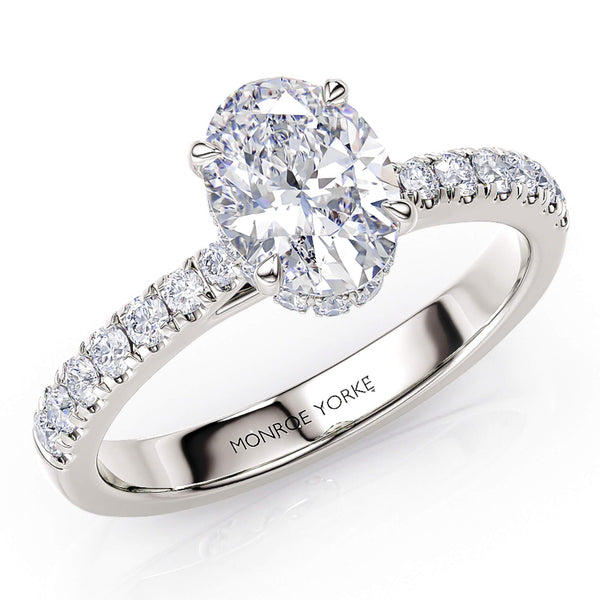
The hidden halo is the engagement ring's best-kept secret, and that's the point. Look at the ring from above, on the hand where a partner or a stranger sees it, solitaire silhouette. Clean, singular, uncluttered. Then tilt the finger. A ring of small pavé diamonds appears beneath the centre stone, throwing light back through the crown, catching sun through the side of the setting where no one thought to look. It's the design equivalent of a well-cut suit lining. Only the wearer knows.

Hand-finished in Australia, set for the secret layer.
Every hidden halo engagement ring in this collection is hand-finished in our Australian workshop by our master jeweller. The centre stone is either a GIA-certified natural or an IGI-certified lab-grown diamond, sourced and graded by our founder Sean Amara, a gemmologist trained at the Gemological Institute of America and HRD Antwerp. The pavé accent stones are matched by hand, G colour or better, VS1 clarity or better, no exceptions, because a hidden halo where the accent stones are dull, mismatched or included is worse than no hidden halo at all.
The hidden halo suits couples who want the clean silhouette of a solitaire and the sparkle depth of a halo without compromising either. It suits diamond buyers who want their ring to feel bigger without looking bigger. It suits people who like their jewellery to have a private layer no photograph fully captures. What follows is our master jeweller's field guide to choosing the right hidden halo engagement ring, including the shape choice that matters most (there's a right answer), the wedding band question no jeweller wants to talk about, and how yellow gold changes the hidden halo effect in ways white gold cannot.
Design your perfect ring.
Collaborate with our master jeweller to create a bespoke hidden halo engagement ring, made only for the person you are proposing to. Free consultation, no obligation. Six to eight weeks in our Australian workshop.
Amy & Jack · Perth · 2026We flew from Perth to see the ring in person and left knowing we'd got something no one else would have. Sean answered every question I didn't know I had.
Every ring, hand-finished by our master jeweller.
Ten stages over four to eight weeks. Design, 3D model, cast, source stones, clean, polish, set, eight hours of final finish, quality check, rectify. No shortcuts.
Cut for perfect light return.
A well-cut diamond throws light back at you across a room. A poorly cut one absorbs it and sits quiet on the finger. That difference is the single biggest thing you'll notice, and it's what we grade every stone against before it goes into a ring.
Cut.Excellent (natural) or Ideal (lab), no exceptions. This is what makes a diamond return light rather than absorb it.
Symmetry and polish.Both graded Excellent. It's why hearts and arrows show up cleanly under a scope.
Fluorescence.None or faint, never medium or strong. Keeps the diamond bright in every light.
Colour.D–G for naturals, D–E for labs. Cool white in yellow gold and platinum, without paying for a D flawless.
The hidden halo ring, in depth.
A gemmologist's field guide. Eleven sections. Fifteen minutes to read. Written by Sean Amara, founder, trained at GIA and HRD Antwerp.
01What a hidden halo actually is
›
A hidden halo is a ring of small pavé diamonds set into the metal directly beneath the centre stone's girdle, the middle line where the crown meets the pavilion. From above, the pavé is invisible. The ring reads as a solitaire. From the side, or when the wearer tilts the finger, the pavé collar catches the light and the ring shows its secret.
The engineering is precise. The pavé sits in a groove cut into the underside of the crown or into the top of the gallery, depending on the setting. The stones are held by tiny beads or micro-prongs raised from the metal itself. Done well, the hidden halo is invisible from the top view but throws light back through the crown of the centre stone, making the whole ring sparkle brighter than a solitaire would. Done badly, the halo either shows from above (which defeats the point) or the accent stones aren't matched properly to the centre (which the eye picks up as visual noise).
Every hidden halo in this collection is set with G-or-better colour and VS1-or-better clarity accent stones. We don't compromise on the halo because the halo IS the design.
02Hidden halo vs regular halo vs double halo, the three-way
›
This is the section most first-time buyers wish they'd read. Three related but genuinely different design choices, easily confused.
Regular halo (visible from above). A ring of small diamonds surrounding the centre stone at the same plane as the crown. Visible in every photo, from every angle. Makes the centre stone look 20-40% larger face-up. Reads as maximum sparkle, maximum presence. Popular. Recognisable.
Hidden halo (visible only from the side). The ring of small diamonds sits BENEATH the centre stone, invisible from the direct top view. Doesn't make the centre stone look bigger from above (the whole point). Adds sparkle through the crown from the side. Reads as understated luxury, a secret only the wearer knows fully.
Double halo (both hidden and visible together). Some settings combine a visible outer halo AND a hidden inner halo beneath the centre stone. Maximum sparkle in every direction. Rare. Distinctly custom. We build this on request.
Which is right for you depends on what you want the ring to say from across a room. Visible halo says "look at this ring." Hidden halo says "look closer." Double halo says both.
03How the setting actually works, the engineering
›
A hidden halo isn't just decoration, it's a specific piece of setting engineering that many jewellers get wrong.
The pavé is held in one of two ways:
Under-crown pavé. The small diamonds are set into a groove machined into the underside of the crown, tucked around the centre stone's girdle. The centre stone appears to float above them. This is the classical hidden halo look.
Gallery-top pavé. The small diamonds sit in a ring set into the top of the gallery (the metal band that holds the prongs). The centre stone is set slightly higher to reveal the halo beneath. This is easier to make but shows the halo more from above at low angles.
Both approaches work. Under-crown pavé is more elegant when done well but requires a taller centre stone (deeper pavilion) to accommodate the groove. Gallery-top pavé works for any centre stone but reads less "hidden" from the top view.
The gallery height matters too. A hidden halo that sits too high off the finger will show the pavé from above and defeat the secret. A hidden halo that sits too low will get dirty faster (see Section 08) and be harder to clean. The right height is a jeweller's judgment call for each specific ring. We settle it during the design consultation.
04Which diamond shape amplifies the hidden halo most
›
Every shape works with a hidden halo. Some show the effect more dramatically than others.
Oval and elongated cushion win. The elongated girdle means more of the pavé collar is visible from the side profile. The hidden halo reads bigger and catches more light on ovals and cushions than on any other shape. If the hidden halo is the feature you love most, these are the shapes to consider first.
Round brilliant is the classic. The tight circular girdle produces a smaller but perfectly symmetrical halo ring. Reads elegant and traditional.
Radiant and princess are strong choices. The rectangular / square shapes give the halo a distinctive geometric character. Some buyers prefer this to the softer round or oval halo.
Emerald and asscher (step cuts) are underrated. The flat table of a step cut lets the hidden halo peek through the girdle in a way that other shapes hide. Beautiful when set correctly.
Pear and marquise take work. The pointed ends of these shapes need the halo tapered to fit properly. Skilled setting is required to avoid the halo looking uneven at the tips.
Our master jeweller has set hidden halos in every shape we sell. Ask which shape best suits the effect you want.
05Yellow gold or white gold hidden halo, the visual difference no one talks about
›
The metal choice for a hidden halo changes the effect in ways no other setting style does. This is worth understanding before you commit.
White gold or platinum hidden halos disappear into the centre diamond. The pavé stones and the metal both read cool and white; they blend into the crown of the centre stone from certain angles. The halo is more of a light-catch than a visual detail. Understated, minimalist, modern.
Yellow gold hidden halos read differently. The warm metal contrasts with the white pavé, making the pavé collar more visibly distinct from the side. The halo becomes a design element you can see, not just a light effect. More decorative, more visually interesting from the side profile.
Rose gold sits between the two, with a slight pinkness that reads romantic. Popular with pear and oval cushion combinations.
Two-tone, a yellow or rose gold band with white gold or platinum under-crown pavé, gives you the best of both. The metal band reads warm, the hidden halo reads bright. One of our most-requested custom builds.
If you want the halo to disappear until seen, choose white gold or platinum. If you want the halo to be a visible design element from the side, choose yellow or rose gold. Both are legitimate choices with different aesthetics.
06Colour and clarity for the accent stones
›
The hidden halo lives or dies on the quality of the accent stones. Poor pavé matching is the single most visible failure mode in a hidden halo.
Colour recommendation: every accent stone should be G or better. Below G, warm tint becomes visible in the halo and creates a colour mismatch against a colourless centre stone. G is the minimum we set. F is standard for our custom builds.
Clarity recommendation: VS1 or better on every accent. Below VS1 and small inclusions become visible in the halo, especially under bright light. Because the halo stones are small (typically 0.01 to 0.03ct each), any visible inclusion is disproportionately obvious.
Matching: every accent stone in the halo should be the same size (within a fraction of a millimetre), the same colour grade, and the same clarity range. Mixed-quality halos look cheap even when the centre stone is spectacular.
This is where a hidden halo bought from a chain jeweller often disappoints. We hand-select every accent stone in every halo we build. Non-negotiable.
07When the hidden halo was actually invented
›
The hidden halo isn't a new setting style, though it's often marketed as one. Small hidden diamond details beneath the centre stone appear in Art Deco pieces from the 1920s and in mid-century American engagement rings.
The modern hidden halo, the specific under-crown pavé aesthetic that dominates today, emerged in the 2016-2017 period. Two things drove it. First, Instagram: the hidden halo photographs stunningly from side angles and finger-up shots, which suited the platform's visual grammar. Second, engagement ring buyers reacting against the "big halo" era of the early 2010s. The hidden halo offered the sparkle appeal of a halo without the visible clutter of one.
Today it's one of the most-requested custom setting features across every design studio we know. The peak of the trend is probably behind us; the durability of the design as a permanent option in the catalogue is now settled.
08Practical wear, does a hidden halo trap dirt?
›
Yes, a bit more than a solitaire. Not as much as a visible halo.
The pavé sits in a recessed position beneath the centre stone, so hand cream, sunscreen residue and everyday grime accumulate faster there than on the exposed surface of a solitaire. Left uncleaned, the halo dulls and the sparkle effect that made you buy the ring disappears.
Cleaning at home is straightforward. Warm water with a drop of mild dish soap, gentle brush with a soft toothbrush, careful attention to the underside of the crown, pat dry. Twice a month is fine for most lifestyles. Weekly if you use hand cream daily.
Professional cleaning at any of our four showrooms every 12 months returns the halo to full brightness. All maintenance is included in our lifetime warranty at no cost.
This is not a reason to avoid a hidden halo. It's a reason to know what you're committing to. Every setting style has a maintenance profile; this is the hidden halo's.
09Will a hidden halo sit flush against a wedding band?
›
Depends on the setting height and the wedding band shape.
The hidden halo sits slightly proud of the finger because the halo adds height beneath the centre stone. A straight wedding band placed next to it will often leave a small gap where the halo protrudes.
Three options:
Contour wedding band. Custom-designed to curve around the hidden halo profile. Sits perfectly flush. Requires a custom band designed to match the specific engagement ring. Not off-the-shelf.
Slightly-tapered wedding band. A band that thins toward the engagement ring side, allowing it to sit closer without contact. Not flush, but the gap disappears from most viewing angles.
Spacer band. A thin plain band worn between the engagement ring and the wedding band, absorbing the height difference. Traditional, elegant, invisible from above.
We custom-design wedding bands for every engagement ring we make. Bring the ring in and our master jeweller will design a matching band that sits correctly. Six to eight weeks in our Australian workshop.
10When to choose hidden halo (and when not to)
›
Choose hidden halo if: you love the solitaire silhouette but want more sparkle depth than a solitaire delivers. You appreciate design details other people don't immediately see. You want the ring to feel bigger without appearing bigger. You're planning to pair the ring with a distinctive wedding band and don't mind custom band design. You're comfortable with a slightly higher-maintenance setting.
Don't choose hidden halo if: you want maximum visible sparkle from every angle (choose visible halo). You want minimum maintenance (choose solitaire or bezel). You want the ring to look as large as possible face-up (choose visible halo). You want a ring that pairs flush with any wedding band off-the-shelf (choose solitaire).
Neither the solitaire, the halo, nor the hidden halo is objectively better. They serve different aesthetics. The hidden halo is the choice for buyers who want a design story with a private layer.
11Care and longevity, the under-halo prong inspection
›
Every hidden halo has 10 to 20 tiny prongs holding the accent stones in place beneath the centre. These prongs are the most maintenance-critical part of the ring.
Bring the ring in to any of our four showrooms every 12 months for a free professional inspection. Our master jeweller checks every prong on the halo under 10x magnification, tightens any that have worked loose, and re-polishes the pavé collar to full brightness. Small maintenance early prevents lost stones later.
Avoid activities where the halo can catch on fabric, winding a scarf, kneading dough, gardening in gloves. The tiny prongs are less exposed than a centre stone's prongs but they can still be bent or worn if snagged repeatedly.
Home cleaning as above. Professional inspection annually. All maintenance covered by our lifetime warranty.
Your questions, answered.
Sixteen of the questions we hear most often across the showrooms.
What is a hidden halo engagement ring?
›
A hidden halo is a ring of small pavé diamonds set into the metal directly beneath the centre stone's girdle, invisible from directly above, visible from the side or when the wearer tilts the finger. The ring reads as a solitaire from the top and reveals its sparkle when viewed at an angle.
How is a hidden halo different from a regular (visible) halo?
›
A regular halo surrounds the centre stone at the same plane as the crown, visible from every angle, and makes the centre stone look 20-40% larger face-up. A hidden halo sits beneath the centre stone, invisible from above, doesn't make the centre look bigger, just adds sparkle from the side. Different aesthetics for different tastes.
What's a double halo, and can I have hidden and visible together?
›
Yes. A double halo combines a visible outer halo AROUND the centre stone AND a hidden inner halo BENEATH it. Maximum sparkle in every direction. It's a distinctly custom design, not usually stocked ready-to-wear, and we build it on request. Six to eight weeks in our Australian workshop.
Do hidden halos make the centre stone look bigger?
›
No, that's a common misconception. A visible halo does. A hidden halo doesn't, because it sits underneath the centre stone and isn't visible from the top view where "face-up size" is measured. If face-up size is your priority, a visible halo is the correct choice. If sparkle depth without visible clutter is what you want, hidden halo delivers it.
Which diamond shapes work best with a hidden halo?
›
Oval and elongated cushion amplify the effect most, the longer girdle means more of the pavé collar is visible from the side. Round brilliant is the classical choice. Radiant and princess give the halo a geometric character. Emerald and asscher (step cuts) let the halo peek through the flat table in a distinctive way. Pear and marquise work but require skilled setting to fit the halo around the pointed ends.
Does the hidden halo trap dirt more than a visible halo?
›
A bit more than a solitaire, less than a visible halo. The pavé sits in a recessed position, so hand cream and sunscreen residue accumulate faster there. Home cleaning with warm water, mild dish soap, and a soft toothbrush every two weeks is enough for most lifestyles. Professional cleaning at any of our showrooms annually, included in our lifetime warranty.
Will a hidden halo engagement ring sit flush against a wedding band?
›
Not always with a straight off-the-shelf band. The halo adds slight height beneath the centre stone. Three options: (1) a contour wedding band custom-designed to curve around the halo (sits flush), (2) a slightly tapered wedding band that thins toward the engagement ring (small gap, mostly invisible), or (3) a thin spacer band worn between the two (absorbs the height difference). We custom-design bands to match every engagement ring we make.
How do I clean a hidden halo engagement ring at home?
›
Warm water with a drop of mild dish soap. Soft-bristled toothbrush. Gently brush the underside of the crown where the halo sits. Pat dry with a soft cloth. Twice a month is fine for most lifestyles, weekly if you wear hand cream daily. Never use ultrasonic cleaners at home, they can loosen the tiny halo prongs. Bring the ring in annually for professional cleaning and prong inspection.
What colour and clarity should the accent stones in a hidden halo be?
›
G colour or better and VS1 clarity or better on every accent stone. Non-negotiable. Below G, warm tint becomes visible and creates a colour mismatch against a colourless centre. Below VS1, small inclusions show disproportionately because the accent stones are small (0.01-0.03ct each). Every halo we build meets both minimums.
Yellow gold or white gold, which suits a hidden halo better?
›
Both work but they look different. White gold and platinum hidden halos disappear into the centre stone from certain angles, the halo becomes a light-catch rather than a visible detail. Yellow gold hidden halos read more decoratively from the side, the warm metal contrasts with the white pavé, making the halo a visible design element. Rose gold sits between the two. Two-tone (warm band, white halo) gives you both.
When was the hidden halo invented?
›
Small hidden diamond details beneath the centre stone appear in Art Deco pieces from the 1920s. The modern hidden halo aesthetic that dominates today emerged in the 2016-2017 period, driven by Instagram-friendly side-angle photography and a reaction against the "big halo" era. The peak of the trend is behind us; it's now a permanent option in most catalogues.
Are lab-grown hidden halo rings cheaper than natural?
›
Yes, typically 40-50% less at the same size and quality. Lab-grown diamonds are chemically, optically, and physically identical to natural diamonds. Every design in this collection can be made with either a GIA-certified natural or an IGI-certified lab-grown centre stone. We don't push one over the other.
How much does a hidden halo engagement ring cost in Australia?
›
Depends on the centre stone and metal. Broad guide: hidden halo settings alone (excluding centre stone) run $1,800 to $4,500 in 18ct gold, $2,500 to $6,000 in platinum. A 1-carat GIA-certified natural round with a hidden halo setting typically sits $8,000 to $13,000 in 18ct gold. The same design with a 1-carat IGI-certified lab-grown centre typically sits $4,000 to $6,500. Custom designs cost 10-25% more than the equivalent stock configuration.
Can I add a hidden halo to an existing engagement ring design?
›
Sometimes. It depends on the original setting, some designs accommodate an under-crown pavé retrofit, some don't. Bring the ring to any of our showrooms for assessment. If it's feasible, our master jeweller will quote the work. Typically two to three weeks.
Which setting protects the centre stone better, hidden halo or bezel?
›
Bezel is more protective. A bezel setting wraps metal fully around the centre stone's girdle, physically shielding it from impact. A hidden halo doesn't add any structural protection to the centre stone. If maximum protection is the priority (active lifestyle, hands-on work), bezel wins. If the sparkle-with-secret aesthetic matters more, hidden halo is the choice.
Can I see hidden halo engagement rings in person at your Sydney, Melbourne, Brisbane or Perth showroom?
›
Yes, and we recommend it more strongly for hidden halos than for any other setting style, the effect is genuinely different in person than in photos. Book a private appointment at any of our four showrooms. Allow forty-five minutes. Bring the recipient if you can, or a photo and their ring size.
See hidden halo in person.
The hidden halo is the setting style that most rewards being seen in person. The pavé collar under the crown is visible only from certain angles, daylight through a showroom window catches it differently than photos. Come in and see three or four hidden halo rings on the recipient's hand from every angle before you commit. Private appointments, no walk-in pressure, one master jeweller and one host per booking.
Every centre stone, certified.
Every engagement ring centre diamond that leaves our Australian workshop carries an independent certificate. Pavé and melee accent stones are hand-selected to match, but are not individually certified.


