




Cushion cut engagement rings,made in Australia.
The cushion cut is what most people mean when they say "a diamond that looks vintage but isn't." Soft rounded corners, a warm romantic glow, and the pillow silhouette that gives the cut its name. It's one of the oldest diamond shapes still in wide production, cut in Europe since the 1800s under the name "Old Mine Cut", refined by Tiffany & Co. in the early 1900s, and reborn in the 2000s when Kim Kardashian's cushion solitaire made the shape mainstream again. Today it sits comfortably in the top four engagement ring shapes in Australia, behind round, oval, and princess.

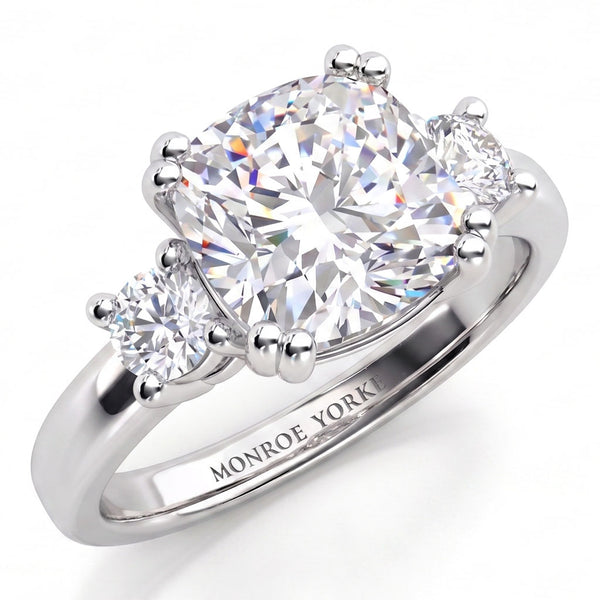
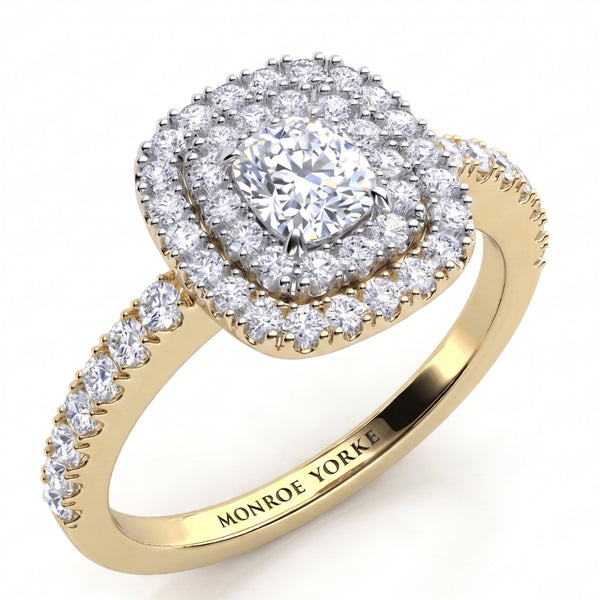
Made in Australia, set for warmth over sharpness.
Every cushion cut engagement ring in this collection is set in eighteen-carat gold or 950 platinum and hand-finished in our Sydney workshop. Every centre diamond is either a GIA-certified natural or an IGI-certified lab-grown, sourced and graded by our founder Sean Amara, a gemmologist trained at the Gemological Institute of America and HRD Antwerp. Every cushion is available in both faceting styles, the modern brilliant "crushed ice" pattern that scintillates in soft light, and the classic "chunky facet" pattern that throws big deliberate flashes like an Old Mine Cut would have done a hundred years ago. Most buyers don't know this choice exists. It's the biggest single decision you'll make on a cushion cut and we walk you through it in person.
The cushion suits couples who want something warm rather than sharp, romantic rather than modern, and unmistakably not what everyone else's ring looks like. What follows is our master jeweller's field guide to choosing the right cushion cut engagement ring, from faceting style to length-to-width ratio to which settings genuinely protect the corners (they all do, but some do it better).
Design your perfect ring.
Collaborate with our master jeweller to create a bespoke cushion cut engagement ring, made only for the person you are proposing to. Free consultation, no obligation. Six to eight weeks in our Australian workshop.
Hamid Reza HeydariI would like to say a very big thank you to Supun, he has been very professional, supportive and created a masterpiece of a ring! Very happy with the service, price and the superior quality of the ring. Thanks again Supun, very very highly recommended.
Every ring, hand-finished by our master jeweller.
Ten stages over four to eight weeks. Design, 3D model, cast, source stones, clean, polish, set, eight hours of final finish, quality check, rectify. No shortcuts.
Cut for perfect light return.
A well-cut diamond throws light back at you across a room. A poorly cut one absorbs it and sits quiet on the finger. That difference is the single biggest thing you'll notice, and it's what we grade every stone against before it goes into a ring.
Cut.Excellent (natural) or Ideal (lab), no exceptions. This is what makes a diamond return light rather than absorb it.
Symmetry and polish.Both graded Excellent. It's why hearts and arrows show up cleanly under a scope.
Fluorescence.None or faint, never medium or strong. Keeps the diamond bright in every light.
Colour.D–G for naturals, D–E for labs. Cool white in yellow gold and platinum, without paying for a D flawless.
The cushion cut ring, in depth.
A gemmologist's field guide. Eleven sections. Fifteen minutes to read. Written by Sean Amara, founder, trained at GIA and HRD Antwerp.
01Why the cushion cut matters now
The cushion is the oldest engagement ring shape still in wide production. Its ancestor, the Old Mine Cut, was cut in Europe from the 1700s through to the early 1900s. When Tiffany & Co. introduced the modern round brilliant in 1919, the cushion nearly disappeared. It sat quietly in estate collections for eighty years.
Then in the early 2000s, three things happened. First, jewellery-brand marketing shifted from "cushion cut" as a vintage style to "cushion brilliant" as a modern one. Second, laser cutting technology let jewellers make cushions with brilliant faceting patterns for the first time. Third, celebrity engagement rings normalised the shape. Kim Kardashian's cushion solitaire in 2011 was the visual reset. By the mid-2010s, cushion sat firmly in the top five most-requested engagement ring shapes globally, and by 2026 it's in Australia's top four.
If you are drawn to a cushion, you are choosing a shape with two centuries of history, refreshed for modern sparkle. There aren't many diamond shapes that can say that.
02Old Mine Cut, Cushion Brilliant, Cushion Modified Brilliant: a decoder
If you are shopping for a cushion cut, you'll see three terms on GIA and IGI reports that all mean slightly different things. Here's what each one is.
Old Mine Cut is the historical predecessor, hand-cut in the 1700s and 1800s before rotary polishing wheels made round brilliants possible. Squarish shape, high crown, small table, big culet. Original Old Mine Cuts are estate pieces, sold as antique. If a jeweller offers you a "new Old Mine Cut," they mean a modern diamond cut in the Old Mine style, beautiful, but distinct from a modern cushion.
Cushion Brilliant is the modern default. Rounded corners, brilliant faceting pattern (58 facets, typically). Sparkles like a round brilliant but in a cushion shape. This is what most jewellers mean when they say "cushion cut" today.
Cushion Modified Brilliant has additional pavilion facets beneath, usually 64 or up to 77 facets total. The extra facets produce the "crushed ice" sparkle pattern (see next section). GIA reports this as "Cushion Modified Brilliant" on the certificate.
These distinctions matter for pricing and for aesthetics. Cushion Brilliant and Cushion Modified Brilliant look genuinely different in the hand. Ask your jeweller which you're being shown.
03Crushed ice or chunky facets? The single biggest cushion decision.
This is the section most cushion buyers wish they'd read before they bought.
Cushion cut diamonds come in two dominant faceting styles, and choosing between them is more consequential than the L/W ratio, the metal, or even the carat weight for how the finished ring will look.
Crushed ice cushion (also called "modern cushion" or "cushion modified brilliant") has extra pavilion facets that break the light into hundreds of small, shimmering flashes. The effect looks like light bouncing off crushed ice or morning dew. Bright rooms make it dance. Soft indoor lighting makes it glow. This is the more popular of the two styles today by roughly 3:1, and it's what most modern cushion engagement rings show.
Chunky facet cushion (also called "chunky flash", "block facet", or "old mine style") has fewer, larger pavilion facets. Instead of hundreds of small flashes, you get big, deliberate flashes of light, like an old-cut diamond viewed by candlelight. It's a more romantic, more vintage, more identifiably "old jewel" look. Some buyers love it precisely because it doesn't look like every other cushion.
Neither is better. They are aesthetically different. Crushed ice is the modern default; chunky facet is the connoisseur's choice. If you're not sure which appeals to you, come to a showroom and see both side by side. Ten minutes and you'll know.
Every cushion in this collection is labelled with its faceting style so you can filter accordingly.
04Length-to-width ratio: square, subtle rectangular, or elongated
A cushion cut can be perfectly square or subtly rectangular, and the L/W ratio on the certificate tells you which.
1.00 to 1.05 is a true square cushion. This is what most people picture.
1.05 to 1.15 is a subtly rectangular cushion. Barely noticeable from directly above; visible from an angle. Elongates the finger a little.
1.15 to 1.30 is a distinctly elongated cushion. Looks longer than wide. Often preferred by buyers who want oval-like elongation without the sharp point at each end.
Above 1.30 starts to look more like an elongated cushion than a classic one. Verges on radiant territory.
Both GIA and IGI report L/W ratio on cushion certificates. Ask for it before you buy.
05Depth, table, and the cushion bow-tie effect
Cushion cuts are more forgiving on depth and table than princess cuts, but the numbers still matter.
Depth: 61 to 68% is ideal. 58-70% is acceptable. Below 58% and the diamond looks flat and dull. Above 70% and light escapes out the bottom instead of reflecting back to your eye.
Table: 58 to 65% is ideal. Wider tables sacrifice fire. Narrower tables sacrifice spread.
The bow-tie effect. Elongated cushions (L/W above 1.15) can develop a dark "bow-tie" shadow across the middle of the diamond, caused by uneven light return along the length. Not every elongated cushion has one, but it's common. Always check the diamond in person or via a video showing all angles before you buy an elongated cushion. If you see a bow-tie shadow, choose a different stone. Every elongated cushion we set is inspected for this before we agree to ship it.
06Corner protection: why cushion is safer than princess
The cushion cut's rounded corners are its structural advantage. Unlike a princess cut, which has four sharp 90-degree corners that chip if the ring catches on fabric or a car door, a cushion's corners are already softened. Chipping is rare.
That said, the corners are still the weakest point on any cushion cut and the setting should still cover them. Two setting styles do this best:
Standard four-prong setting with prongs positioned at each of the four rounded corners. This is the classic cushion solitaire setting and it works in nearly every case.
Bezel or half-bezel setting wraps metal fully around the diamond's girdle, giving maximum protection. Best for active lifestyles, but the metal covers more of the stone visually.
You do NOT need V-prongs on a cushion (those are for princess cuts, where the sharp corners require special protection). Standard round prongs work fine.
07Colour and clarity in a cushion cut
The cushion cut hides colour and clarity better than a princess but not as well as a round. Its wider table and brilliant faceting are forgiving, but the softer sparkle pattern (especially in crushed ice cushions) can also make small warmth or inclusions more visible than in a round of equivalent grade.
Colour recommendations. In white metal, choose G to H for a colourless appearance. Below H and slight warmth becomes visible. In yellow gold, you can drop to I to J because the warm metal absorbs some tint.
Clarity recommendations. Crushed ice cushions with many small facets hide inclusions well, SI1 is often eye-clean. Chunky facet cushions have larger facets that can show inclusions more clearly, aim for VS2 or better. Ask your jeweller to check the specific stone under 10× magnification before you commit.
Every cushion cut we set is checked against its setting for face-up clarity before shipping.
08Cushion vs round, princess, oval, radiant
Buyers considering a cushion usually cross-shop two or three other shapes. Here's the honest comparison.
Cushion vs round brilliant. Round has more overall sparkle and reads brighter in low light. Cushion has a softer, warmer glow. Cushion is 10-15% cheaper per face-up size. Round for maximum sparkle; cushion for romance and warmth.
Cushion vs princess. Both are square-ish, but the aesthetic is completely different. Princess is sharp, modern, geometric. Cushion is soft, vintage, romantic. Princess has the chip risk from sharp corners. Cushion doesn't. If you like square but want warmth, cushion. If you like square and want modern, princess.
Cushion vs oval. Both can be elongated. Oval is more strictly brilliant-cut with no corners; cushion has soft corners and warmer character. Oval elongates the finger more dramatically. Cushion reads more historical.
Cushion vs radiant. Both are rectangular brilliant cuts with softened corners. Radiant has cropped 45-degree corners; cushion has rounded corners. Radiant sparkles crisper; cushion glows softer. Radiant is more modern; cushion is more vintage. Different aesthetics.
09Setting styles that suit a cushion cut
Solitaire in a four-prong setting is the truest cushion expression. Warm, uncluttered, corner-protected. If you're not sure, this is the safe choice.
Halo is the most popular custom request we build for cushions. A halo of small round diamonds around the cushion adds sparkle without changing the metal warmth, and the small round diamonds around a cushion centre make the overall face-up size 20-25% larger without changing the centre stone. Excellent value.
Hidden halo. A ring of small diamonds tucked under the cushion, invisible from above but visible from the side. Modern, subtle, romantic. Growing in popularity.
Three stone (trilogy). Cushion centre with two round or smaller cushion side stones. Reads distinctly vintage-inspired. Popular for those who want a heritage feel.
East-west set. Elongated cushion set horizontally rather than vertically. Distinctly modern, distinctly unusual. Not for everyone but a striking choice.
10Metal pairings: cushion loves warm metal
The cushion cut's soft geometry and warm glow pair naturally with warm metals. This is different from a princess cut, where warm metals can feel discordant. Cushion sings in yellow gold and rose gold, and equally well in white gold and platinum.
Yellow gold is the historically correct choice, cushions were originally cut for yellow gold settings. A cushion solitaire in yellow gold looks like a genuine antique inspired piece. Excellent.
Rose gold with a cushion is one of the most romantic combinations in fine jewellery. The pink metal amplifies the cushion's warm character. Particularly beautiful with morganite or pink sapphire centres.
White gold and platinum give the cushion a cleaner, more contemporary look. The cool metal balances the warm sparkle. If you want the cushion to feel modern rather than vintage, choose cool metal.
Two-tone, yellow or rose gold band with white gold or platinum head, is a considered choice that gives you both.
11Wedding band pairings for cushion cut
The cushion cut's soft rounded shape pairs beautifully with several wedding band styles:
Plain solid band, the classic minimalist pairing. Lets the cushion speak.
Diamond half-eternity band with round diamonds, the round sparkle of the band complements the cushion's brilliant faceting.
Contour band custom-designed to hug the cushion setting, sits flush with no gap. Requires custom design or a matched set.
Milgrain-detailed band in yellow or rose gold, adds a vintage flourish that echoes the cushion's historical character.
Curved band to nest around a halo cushion setting, sits gracefully alongside without a gap.
We custom-design wedding bands to match every engagement ring we make. Bring your finished engagement ring to any of our four showrooms and our master jeweller will design a matching band.
Your questions, answered.
Sixteen of the questions we hear most often across the showrooms.
What is a cushion cut engagement ring?
A cushion cut engagement ring is a diamond with a squarish or subtly rectangular shape and rounded corners, the shape of a pillow. It's one of the oldest engagement ring shapes still in wide production, cut since the 1700s, refined by Tiffany in the early 1900s, and popular again from the 2000s onwards.
What's the difference between crushed ice and chunky (checkerboard) faceting on a cushion?
Two dominant faceting styles. Crushed ice cushions have many small pavilion facets that break light into hundreds of tiny shimmering flashes, a soft, dew-like sparkle. Chunky facet cushions (also called chunky flash or old mine style) have fewer, larger pavilion facets that produce big, deliberate flashes like an old-cut diamond. Neither is better. Crushed ice is more popular today (about 3:1) and reads more modern. Chunky facet is more vintage and more distinctive. See both in person before choosing.
How many facets does a cushion cut have?
A standard Cushion Brilliant has 58 facets, the same brilliant faceting pattern as a round brilliant, in a cushion shape. A Cushion Modified Brilliant has additional pavilion facets (typically 64 total, sometimes up to 77) that produce the crushed ice sparkle pattern. GIA reports this on the certificate as "Cushion Brilliant" or "Cushion Modified Brilliant."
What length-to-width ratio should I choose for a cushion?
For a true square, choose 1.00 to 1.05. For a subtly rectangular cushion that elongates the finger slightly, choose 1.05 to 1.15. For a distinctly elongated cushion, choose 1.15 to 1.30. Above 1.30 verges on radiant territory. Both GIA and IGI report L/W ratio on cushion certificates.
What's the difference between an Old Mine Cut, a Cushion Brilliant, and a Cushion Modified Brilliant?
Old Mine Cut is the historical predecessor from the 1700s-1900s, hand-cut with a high crown, small table, and big culet, typically only found in estate pieces today. Cushion Brilliant is the modern default with 58 facets in a brilliant pattern. Cushion Modified Brilliant has extra pavilion facets (typically 64-77 total) that produce the crushed ice sparkle. Ask which one you're being shown before you buy.
Do cushion cut diamonds have a "bow-tie" effect?
Sometimes, in elongated cushions (L/W above 1.15). A bow-tie is a dark shadow across the middle of the diamond caused by uneven light return along the length. Not every elongated cushion has one, but it's common. Always inspect an elongated cushion in person or via a 360-degree video before you buy. If you see a bow-tie shadow, choose a different stone.
What colour grade should I choose for a cushion?
In white metal (white gold, platinum) choose G to H for a colourless appearance. In yellow gold you can drop to I to J because the warm metal absorbs some of the tint. Cushions hide colour better than princess cuts but not as well as round brilliants.
What clarity grade should I choose for a cushion?
Depends on faceting style. Crushed ice cushions with many small pavilion facets hide inclusions well, SI1 is often eye-clean. Chunky facet cushions have larger facets that show inclusions more clearly, aim for VS2 or better. Ask your jeweller to check the specific stone under 10× magnification before you commit.
Does a cushion cut sit flush against a wedding band?
A cushion solitaire in a low-set four-prong setting sits comfortably flush with most straight wedding bands. Halo cushions typically don't sit fully flush, the halo takes up space between the centre stone and the wedding band. If flush-fit is important to you, we design custom contour bands that hug the cushion setting exactly.
Cushion cut vs round brilliant, which is better?
Round has more overall sparkle and reads brighter in low light. Cushion has a softer, warmer glow and reads more romantic. Cushion is 10-15% cheaper per face-up size. Round for maximum sparkle. Cushion for romance and warmth.
Cushion cut vs princess, what's the difference?
Both are square-ish, but the aesthetic is completely different. Princess is sharp, modern, geometric with 90-degree corners that need V-prong protection to prevent chipping. Cushion is soft, vintage, romantic with rounded corners that don't chip. If you like square but want warmth, cushion. If you like square and want modern, princess.
Cushion cut vs oval, what's the difference?
Both can be elongated. Oval is strictly brilliant-cut with no corners. Cushion has soft corners and warmer character. Oval elongates the finger more dramatically. Cushion reads more vintage. Similar price. Different aesthetics.
Which wedding band suits a cushion cut engagement ring?
Several styles work. A plain solid band is the classic minimalist pairing. A diamond half-eternity band with round diamonds complements the cushion's sparkle. A contour band custom-designed to hug the setting sits perfectly flush. Milgrain-detailed bands in yellow or rose gold echo the cushion's vintage character. We custom-design wedding bands to match every engagement ring we make.
Does yellow gold work with a cushion cut?
Yes, extremely well. Yellow gold is historically correct for cushions, the shape was originally cut for yellow gold settings. A cushion solitaire in yellow gold reads as a genuine vintage-inspired piece. Rose gold with cushion is one of the most romantic combinations in fine jewellery. Cool metals (white gold, platinum) also work and give a cleaner, more contemporary look.
Are lab-grown cushion cuts cheaper than natural cushion cuts?
Yes, typically 40-50% less at the same size and quality. Lab-grown diamonds are chemically, optically and physically identical to natural diamonds. Every design in this collection can be made with either a GIA-certified natural or an IGI-certified lab-grown cushion. We don't push one over the other, we help you decide based on what you want.
Can I see cushion cut engagement rings in person at your Sydney, Melbourne, Brisbane or Perth showroom?
Yes. We recommend it, especially for cushions, the crushed ice vs chunky facet choice genuinely can't be made from a photo. Book a private appointment at any of our four showrooms. Bring the recipient if you can, or a photo and their ring size. Allow forty-five minutes.
See cushion cut in person.
A cushion cut looks different in person than it does through a screen. The soft rounded corners catch light differently at every angle, the depth reads warmer in daylight than under showroom lights, and the choice between crushed ice and chunky faceting genuinely can't be made from a photo. If you are within travel distance of one of our four showrooms, come in and see three or four cushion cut rings on the recipient's hand before you commit. Private appointments, no walk-in pressure, one master jeweller and one host per booking.
Every centre stone, certified.
Every engagement ring centre diamond that leaves our Australian workshop carries an independent certificate. Pavé and melee accent stones are hand-selected to match, but are not individually certified.


